Shift vs Sheath vs A-Line Dresses: Differences in Shape and Fit
The main difference between a shift and a sheath dress is how closely the dress follows the waist and hips. A shift generally falls more freely through the waist; a sheath has a more closely shaped outline. An A-line dress widens toward the hem, often pairing a fitted upper body with a roomier skirt.
Choosing between them starts with a practical question: where do you want definition, and where do you want more room? You might prefer a relaxed waist for one day, a tailored pencil skirt for another, or an A-line skirt that opens away from the legs.
The shape is only part of the decision. Fabric, lining, seams and proportions affect how each dress feels. This guide compares those differences using dresses at BTK COLLECTIONS. For instructions on measuring and selecting a size, use our guide to choosing your dress size online.
Shift vs Sheath Dress: The Differences at a Glance
Look beyond a straight-looking hem. The more revealing detail is what happens between the shoulders and hips: does the dress skim past the waist, or curve inward to define it?
| Fit feature | Shift dress | Sheath dress | A-line dress |
|---|---|---|---|
| Overall outline | Relatively straight or gently widening | Follows the bust, waist and hips | Widens toward the hem |
| Waist shaping | Usually limited; some gentle shaping is possible | Usually clearly shaped | Varies; often fitted above a flared skirt |
| Hip room | Depends on the width of the straight cut | Usually a closer fit | Often greater where the skirt flares |
| Main fit checkpoints | Shoulders, bust and hip clearance | Bust, waist, hips and torso length | Bodice, waist and flare position |
| Movement | Depends on skirt width, fabric and length | Stretch, vents or slits can help | Skirt volume can help; lining still matters |
These are typical characteristics, not promises about every dress. Silhouette names can overlap: a shift may widen slightly into an A-line outline, and a fitted-bodice A-line dress may fit closely above the waist.
What Is a Shift Dress? A Straighter Shape with Less Waist Emphasis
A shift dress falls from the shoulders with relatively little waist suppression. It can be straight or gently widening, with enough shaping to sit neatly at the bust without creating a strongly cinched waist. Sleeves, embellishment and hem length vary; a shift does not have to be plain or sleeveless.
Are shift dresses loose fitting?
They usually have less waist definition than sheaths, but “shift” does not mean oversized. A gently shaped shift can skim the body. It may also fit more closely across the bust or hips than you expect from a front photograph.
The Renee C Grey Plaid Notched V-Neck Sleeveless Shift Dress illustrates this nuance. Its outline is relatively straight with gentle shaping, rather than a completely boxy cut. The checked pattern makes it easier to follow the line through the torso and skirt.

- Look for comfortable shoulder and bust placement.
- Check that the skirt clears the hips without persistent pulling.
- Consider seated coverage, especially with an above-knee style.
A shift is a useful starting point when you want less emphasis at the waist, but the garment’s actual cut still determines the amount of room.
What Is a Sheath Dress? A Shape That Follows the Body
A sheath dress is shaped through the torso and hips, usually continuing into a relatively straight or narrowed skirt. Darts, curved seams or panels can create the contour. A visible waist seam is not essential, and a sheath need not cling like a stretch bodycon dress.
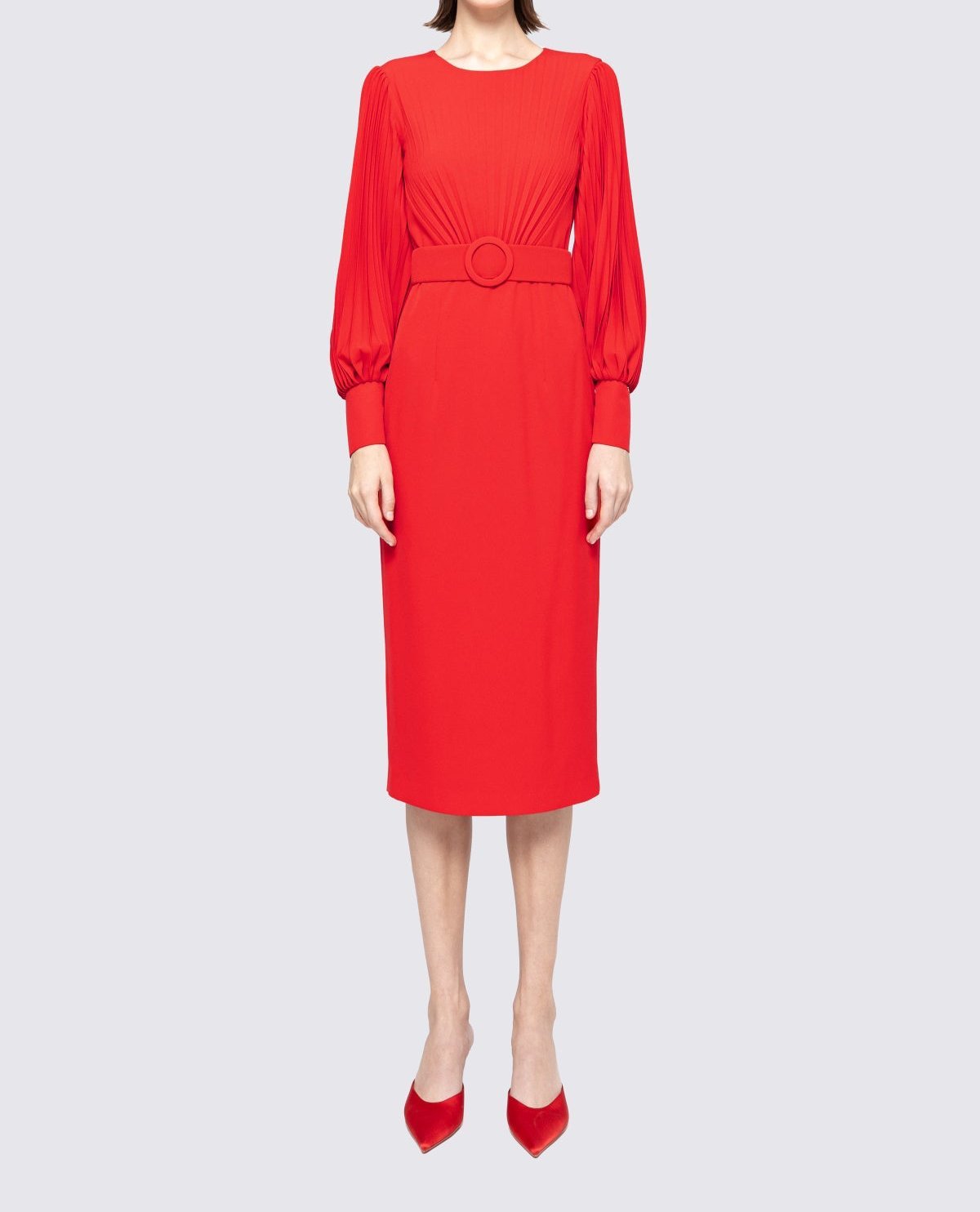
The NISSA Red Pleated Belted Pencil Midi Dress demonstrates a sheath-like pencil silhouette: a defined waist, closer hip line and narrow skirt. Its pleated bodice and sleeves add detail above the waist without making the skirt full.

How should a sheath dress fit?
A well-fitting sheath should allow you to sit, walk and reach without constant adjustment. Persistent horizontal pulling, a zipper under strain or a skirt that repeatedly rides upward can indicate a fit issue. A single fold caused by movement is not the same as persistent tension.
- Bust: The fabric should sit without sustained pulling or unwanted neckline gaps.
- Waist: Shaping should fall in a comfortable position on your torso.
- Hips: The skirt should follow the outline while allowing normal movement.
- Hem: A slit or vent can help with stride, but cannot compensate for an overly tight skirt.
Do not automatically size up or down because the dress is a sheath. Start with its published size information and construction. A larger size may add room while also changing the neckline, shoulders and waist placement.
What Is an A-Line Dress? A Skirt That Widens Toward the Hem
An A-line outline becomes wider toward the hem. Some dresses achieve that shape below a fitted waist; others widen from higher on the body. The point where the flare begins affects how much room the dress offers through the waist and hips.
The Sugarlips Strella Navy Faux Leather A-Line Midi Dress has a shaped bodice, defined waist and paneled skirt that widens below it. Its surface and seams make the change from fitted upper body to flared skirt easy to see.

An A-line skirt does not guarantee a loose waist
Strella is a good example: the skirt has volume, but the waist remains defined. If you prefer little pressure around the waist, look at the bodice construction instead of relying on the A-line label. Also consider the lining, when present; a narrower lining can limit movement beneath a full outer skirt.
A-Line vs Sheath vs Shift: Choose Where You Want More Room
Use your wearing preferences to narrow the choice. There is no need to assign yourself a body-shape category or assume that one silhouette works for everyone.
| Your preference | Start by considering | Still check |
|---|---|---|
| Less emphasis at the waist | A shift with limited waist shaping | Bust and hip clearance |
| A defined waist and narrow skirt | A sheath or pencil dress | Torso alignment and seated comfort |
| A shaped upper body and roomier skirt | A fitted-bodice A-line dress | Waist fit and where the flare begins |
| Less skirt volume | A sheath or straighter shift | Walking room and hem width |
| More movement around the legs | An A-line skirt | Fabric weight, length and lining |
For example, choosing between a straight shift and an A-line dress is not simply choosing “loose” versus “fitted.” The shift may offer more room at the waist, while the A-line offers more room below it. Decide which area matters most to you.
Fabric, Lining and Construction Change How a Dress Wears
Two dresses with the same silhouette can feel very different. A soft fabric may fall close to the body, while a more structured material holds a clearer outline. Neither fabric composition nor an image alone tells you exactly how much stretch a garment has.
| Construction detail | What it changes |
|---|---|
| Structured fabric | Can hold a distinct outline and make seams or panels more visible. |
| Fluid fabric | Can drape nearer the body even when the pattern is relatively relaxed. |
| Stretch | May support movement, but the amount and direction of stretch matter. Elastane content is not a size recommendation. |
| Lining | Can fit and stretch differently from the outer fabric. |
| Darts and curved seams | Create shaping without requiring a separate waist seam. |
| Pleats and gathers | Add fullness in specific areas; bodice pleating does not imply a roomy skirt. |
| Vent or slit | Can increase stride in a narrow skirt. |
| Belt | Changes waist emphasis without changing the underlying pattern. |
BTK COLLECTIONS Dress Construction Comparison
These three dresses show different balances of waist definition and skirt room. Use the construction details alongside each product’s published sizing guidance. Prices, available sizes and purchase terms are shown on the linked product pages.
| Dress and image | Construction and fit comparison |
|---|---|
| Renee C Grey Plaid Notched V-Neck Sleeveless Shift Dress |
Shape: Gently shaped straight shift; less waist emphasis than the belted NISSA example. Design: Grey base with black and white checks, notched V-neck, sleeveless cut, covered back and straight hem. Above-knee on the model. Fabric: 98% polyester, 2% spandex. The percentage does not establish the amount of stretch. Lining and closure: Not specified in the published description. Fit focus: Bust and hip clearance, armhole fit and seated hem coverage. Measurement reference: Model wears S; listed height 5′9″, waist 25″ and bust 32B. These describe the model, not the garment. No numerical garment length is provided. Sizing note: XL and 1X should not be treated as interchangeable; the product’s offered labels and supplied chart differ at that point. Care and origin: Follow the garment care label. Made in the USA. Occasion: Business-casual days, lunch and brunch where the length suits the setting. Coordinating jacket is sold separately. |
| NISSA Red Pleated Belted Pencil Midi Dress |
Shape: Tailored pencil silhouette with sheath-like shaping through the waist and hips. Design: Red, wide rounded neckline, pleated bodice and long sleeves, fabric belt with buckle, and narrow midi skirt. Fabric: 96% polyester, 4% spandex. Lining: 94% polyester, 6% elastane. The product description identifies stretch; shell and lining percentages do not establish identical stretch. Closure and movement: Back zipper and back slit. Fit focus: Bust, waist and hip fit; belt placement; comfort when sitting and walking. Measurements: No numerical finished garment measurements are supplied in the description. Use the product’s published size chart. Care: Dry cleaning recommended. Occasion: Professional functions, dinner parties and celebrations suited to a tailored midi. Dress-code requirements still apply. |
| Sugarlips Strella Navy Faux Leather A-Line Midi Dress |
Shape: Fitted bodice and defined waist opening into a paneled A-line skirt. Design: Navy faux leather with subtle sheen, high round neckline, sleeveless cut, panel stitching and midi length. Fabric: 55% polyester, 45% polyurethane. This is faux leather. Lining and stretch: Not specified in the published description; do not assume either. Closure: Center-back zipper. Fit focus: Bust, waist and armholes; the skirt’s flare does not make the waist adjustable. Published measurements: Size S: chest 18″ and length 50″. The description does not specify the chest measurement method, so 18″ should not be treated as a body bust circumference. Model is 5′9″ and wears XS. Care: Hand wash only; follow the sewn-in care label for washing and drying. Occasion: Dinner, gallery openings, theater and business-casual settings where a leather-look finish is appropriate. |
Shift or Sheath Dress for Work?
Both can work in a professional wardrobe. A structured shift provides a relatively straight outline with less waist emphasis; a sheath provides a more closely tailored shape. An A-line dress offers another option when you prefer definition through the upper body with more skirt volume.
The workplace matters as much as the silhouette. A grey plaid shift may suit a business-casual day, while a red pencil midi makes a stronger visual statement. Strella’s leather-look surface belongs in workplaces that welcome that finish, even though its shape is tailored.
Before settling on a work dress, check the activities you actually perform:
- Sit comfortably at a desk and check the hem position.
- Reach forward without persistent pulling across the back or bust.
- Check neckline and armhole coverage during movement.
- Try your intended jacket over the sleeves and shoulders.
- Walk at a normal pace, including stairs if relevant.
For more on workplace coverage and styling, read Women’s Work Dresses: How to Choose Professional Dresses for the Office.
A-Line or Sheath Dress for a Wedding Guest?
Choose the level of formality from the invitation, then compare fit. An A-line skirt can provide more space around the legs; a sheath offers a closer outline and may rely on a slit, vent or stretch for movement. A shift can also suit an event when its material, finish, length and coverage meet the dress code.
No silhouette is automatically formal. A daytime plaid shift and an embellished evening shift share a general shape but serve different occasions. Likewise, an A-line sundress and an evening A-line dress are not interchangeable.
Consider sitting through dinner, walking on the venue’s surfaces and dancing in the complete outfit. Use our wedding guest outfit guide for the broader occasion decision.
Sheath vs Bodycon, A-Line vs Fit-and-Flare, and Other Common Comparisons
Sheath vs bodycon dress
A sheath follows the body’s contours, often through tailoring. Bodycon describes an intentionally very close fit, commonly achieved with stretch. They can overlap, but a sheath does not need to cling. Assess the intended fit and construction rather than treating the words as synonyms.
A-line vs fit-and-flare dress
Fit-and-flare emphasizes the contrast between a fitted upper body and a flared skirt. A-line describes the widening outline. A fitted-bodice A-line dress can therefore be both, while an A-line dress that widens from higher on the torso may have little waist definition.
Shift dress vs straight dress
“Straight” describes an outline; “shift” usually also suggests limited waist shaping. A dress can have a straight skirt and a fitted torso, so a straight-looking photograph does not establish that it is a shift.
How to Identify a Dress Silhouette Online
- Compare front, side and back views. A single pose can conceal waist shaping or skirt volume.
- Find the waist. Look for curved seams, darts, a waistband or a belt. Identify which features create the definition.
- Follow the outline through the hips. Does it stay close, fall relatively straight or open outward?
- Look for fullness. Pleats, gathers and panels may add room in different places.
- Read fabric and lining details. Do not infer stretch from shine or softness in an image.
- Choose the shape, then select the size. Use the published chart and garment details rather than a universal conversion.
If the image and silhouette name seem different, give more weight to the visible construction and detailed description. The most useful question is how that particular dress is shaped.
Frequently Asked Questions About Shift, Sheath and A-Line Dresses
What is the difference between a shift and a sheath dress?
A shift generally has less waist shaping and a straighter fall. A sheath follows the torso and hips more closely. Both can have relatively straight skirts.
Are shift dresses always loose fitting?
No. Some skim the body with gentle shaping. Check bust and hip clearance rather than assuming a shift is roomy everywhere.
Does a sheath dress have to be tight?
No. It should follow the body while allowing the movement needed for the occasion. Persistent pulling or repeated adjustment can indicate a fit issue.
Which dress silhouette has more room at the hips?
An A-line dress often provides more room where the skirt flares, but the position of the flare, the size and the lining determine the actual room.
Can an A-line dress have a fitted waist?
Yes. A fitted waist above a widening skirt is a common A-line construction. The skirt shape does not make the waist loose or adjustable.
Can a shift dress also be A-line?
Yes. A dress with little waist shaping may widen gently toward the hem. These terms can describe different aspects of the same garment.
Is a sheath dress the same as a bodycon dress?
No. Bodycon suggests a deliberately close, clinging fit. A sheath can achieve a shaped outline through tailoring without that degree of closeness.
Is A-line the same as fit-and-flare?
They overlap. Fit-and-flare specifically emphasizes a fitted upper body and flared skirt; A-line describes the widening outline more broadly.
Is a shift or sheath dress better for work?
Either can suit work. Choose according to the workplace, coverage, seated comfort and your preference for a straighter or more closely shaped outline.
Does adding a belt turn a shift into a sheath?
No. A belt draws in fabric at the waist but does not change the dress’s underlying seams or hip shaping. It may create gathers rather than a tailored sheath fit.
Choose Your Dress Shape, Then Check the Fit
Start with a shift when you prefer less waist shaping, a sheath when you want a closer outline through the torso and hips, or an A-line when you want a skirt that widens toward the hem. Then assess the individual fabric, lining and proportions.
Explore the featured Renee C shift, NISSA pencil midi and Sugarlips Strella A-line midi. Use How to Choose Your Dress Size Online for the next step: interpreting measurements and selecting your size.